Passer au contenu principal
30 jours de révocation
Hotline: 030 - 7017 4848 0 (lu – ve: 11h00 – 16h00)
Expédition mondiale

Perpendicularity and flatness of hand planes

In order to work precisely, a hand plane should have a flat, i.e. straight sole. In addition, for planes that are also used for jointing, this sole should be at a right angle to the side walls of the plane body. In planing, "jointing" refers to the processing of board edges to create a right angle to the side of the board. This step is essential for clean gluing. 

With the planes we sell, it often happens that both the flatness of the sole and the right angle to the sides of the plane are criticized as inadequate. In most cases, our inspection leads to the conclusion that the plane is fine. How do these discrepancies arise?
1. There is a perception that the angle or sole must be absolutely precise. This is only possible in theory: depending on the accuracy of the measuring device, there will always be some deviation. The key factor is that the deviation must be negligible in practical use. Specified tolerances, which must be adhered to in production, help to achieve this.

2. The accuracy requirements for metalworking are uncritically transferred to woodworking. Wood is an organic material that can change shape during processing. Simply cutting a straight board can result in two crooked halves because tension is released during cutting. This also happens with metal, but not to the same extent as with wood.

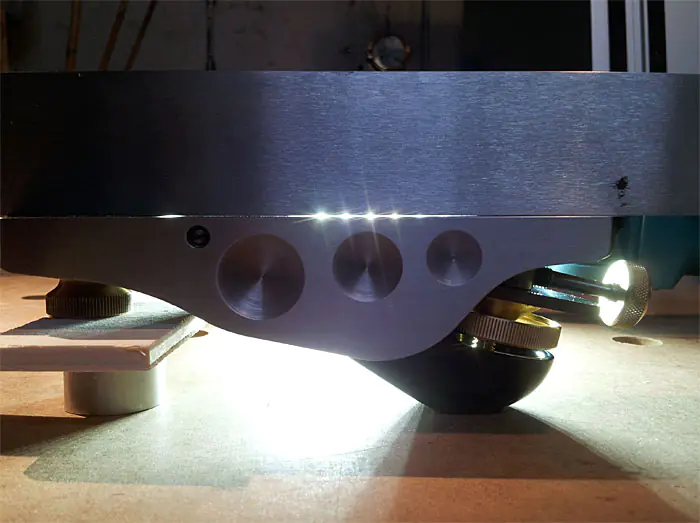
3. Inadequate measuring methods often produce incorrect results or exaggerate the appearance of the deviation, such as a hairline ruler. We occasionally receive photos with a hairline ruler placed on the sole of the plane, which shows a clear gap of light and suggests that the deviation is significant—but without precise information on how wide the gap of light is. With a hairline ruler or a straight edge, you can already see deviations of a few thousandths of a millimeter in sharp focus, as in this image on the right. This is not practical.

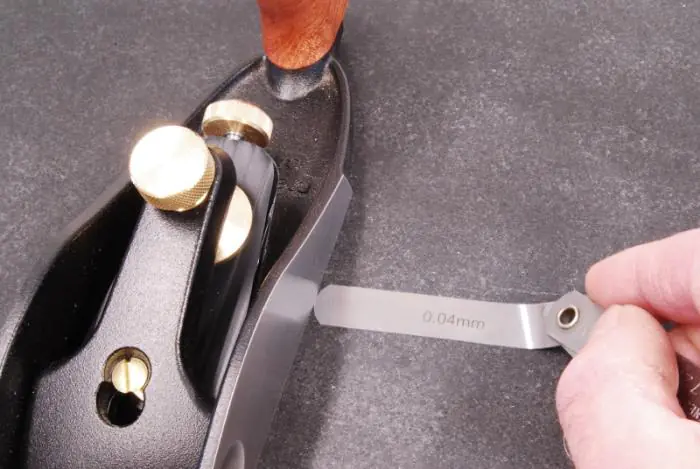
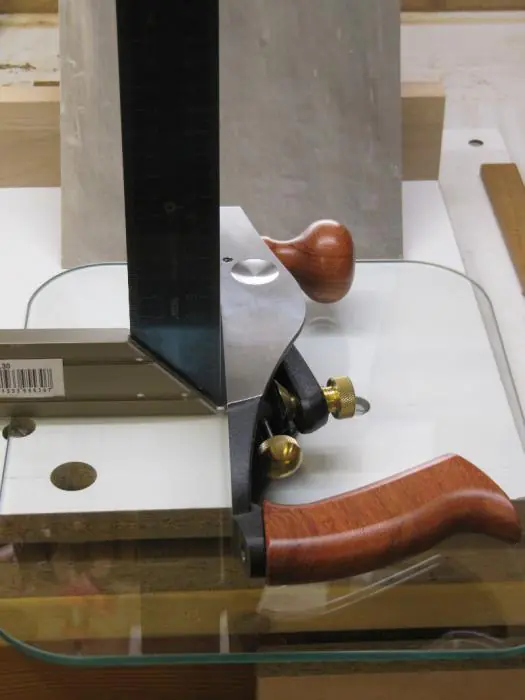
4. Another inadequate measuring method is the use of an inaccurate angle on an area that is far too small, so that only half of the leg rests on the plate. The image suggests a planer sole that is far outside the right angle in relation to the side walls. During our inspection (see below), we found that at no point, regardless of the test arrangement, did the 0.04 mm thick feeler gauge between the measuring device and the reference edge on the plane touch. 0.04 mm is 1/25 mm!

How we check the perpendicularity of the side to the sole and the flatness of the sole:

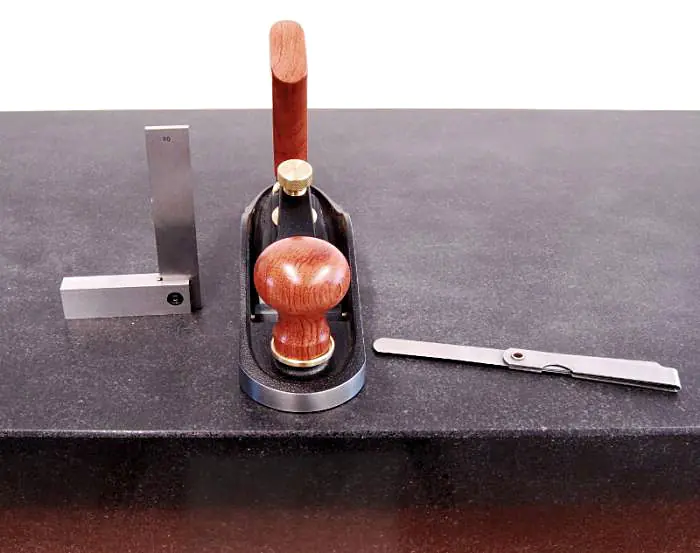
We use the following:

1. A calibrated, high-precision granite slab
2. A calibrated square with an accuracy of GG 0
3. A feeler gauge

This setup is the same as recommended and used by leading plane manufacturers. It is important that the sole of the plane itself cannot serve as a reference surface, but only as a neutral base, a kind of auxiliary reference point, which must be very precise. Particular attention must be paid to ensuring the surface is clean, as this can affect the result. A calibrated square (not a hair square) is then placed on the granite slab and brought close to the sides. If no gap is visible, the accuracy is perfect. If a gap is visible, a feeler gauge must be used at the open end of the gap. If a 0.002 inch (0.05 mm) feeler gauge does not fit between the two, the accuracy is within tolerance for manufacturers such as Veritas. If higher accuracy is desired—though far from practical for woodworking—it must be achieved by the user using standard lapping techniques. With Juuma planes, a 0.15 mm feeler gauge should not fit between the plane and the surface.

To measure the flatness of the sole, place the plane on the granite slab and attempt to insert a feeler gauge at various points. The tolerances are as described above (this applies to Veritas planes; a higher tolerance must be accepted for less expensive models).
Here are the measurement results for this plane:
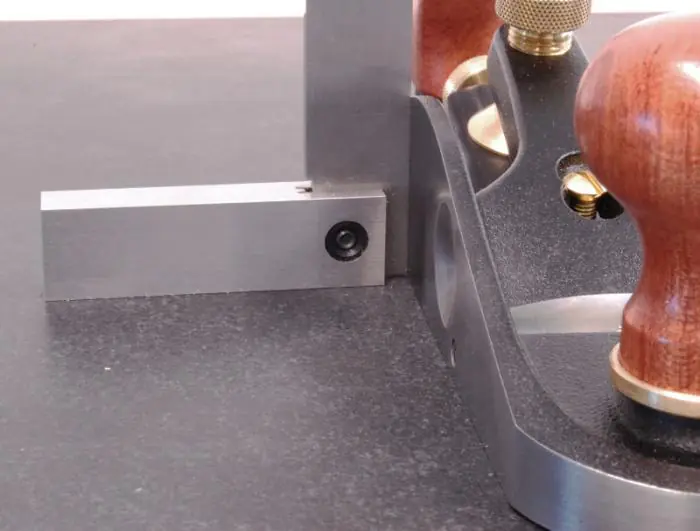
Left side from the front: the measuring angle shows no light gap, everything is perfect!

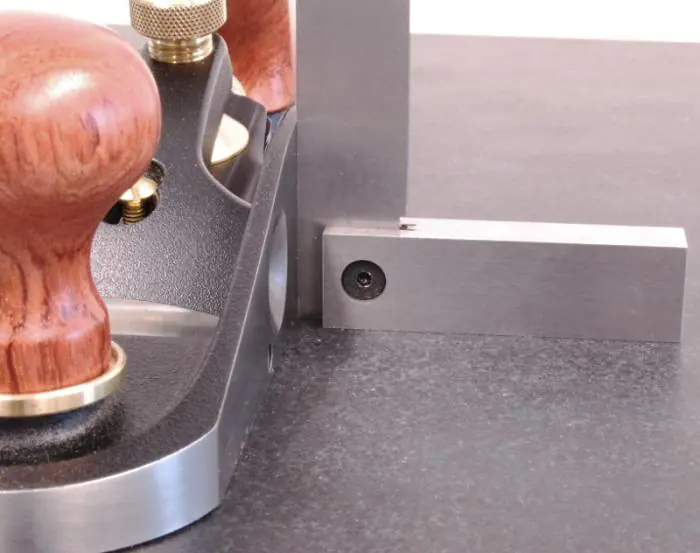
Right side from the front: the measuring angle shows no light gap, also perfect!

Flatness of the sole: A feeler gauge of 0.04 mm (that is 1/25 millimeter) does not go under the sole of the plane at any point.

Conclusion: the plane is perfectly fine.

We generally recommend checking the measuring equipment used carefully and also considering other sources of error. When testing with your own equipment, you will probably not have the same equipment available as we do. However, you can approximate this test setup with simple means. Instead of a granite plate, a glass plate will often do; you should have at least one good, tested angle in your workshop. You will need a feeler gauge, but this is not expensive.

Zugehörige Produkte

20% Remise
Plaque de surface en granit 18 x 6 x 2 pouces (457 x 152 x 51 mm)

50,32 €* 62,90 €*
Prix TTC, frais de livraison en sus

Disponible, délai de livraison : 1 à 3 jours ouvrables en Allemagne